
Search Engine Optimization (SEO) consists in optimizing your website so that it can rank higher in the organic search results in search engines, making your website more popular among web users.
It is the process of optimizing the website content, keywords, technical structure, user experience and even external links to better enable a search engine to crawl, find and rank a website or page.
SEO is a combination of on-page, off-page, and technical elements that help you increase your visibility online.
A Good Degree of SEO on a Website can Generate High Traffic and sales, plus Brand Recognition. It also emphasizes on content relevancy and user experience; it has utmost importance in digital marketing, which can make a business continue growing and be successful.
How does SEO work?
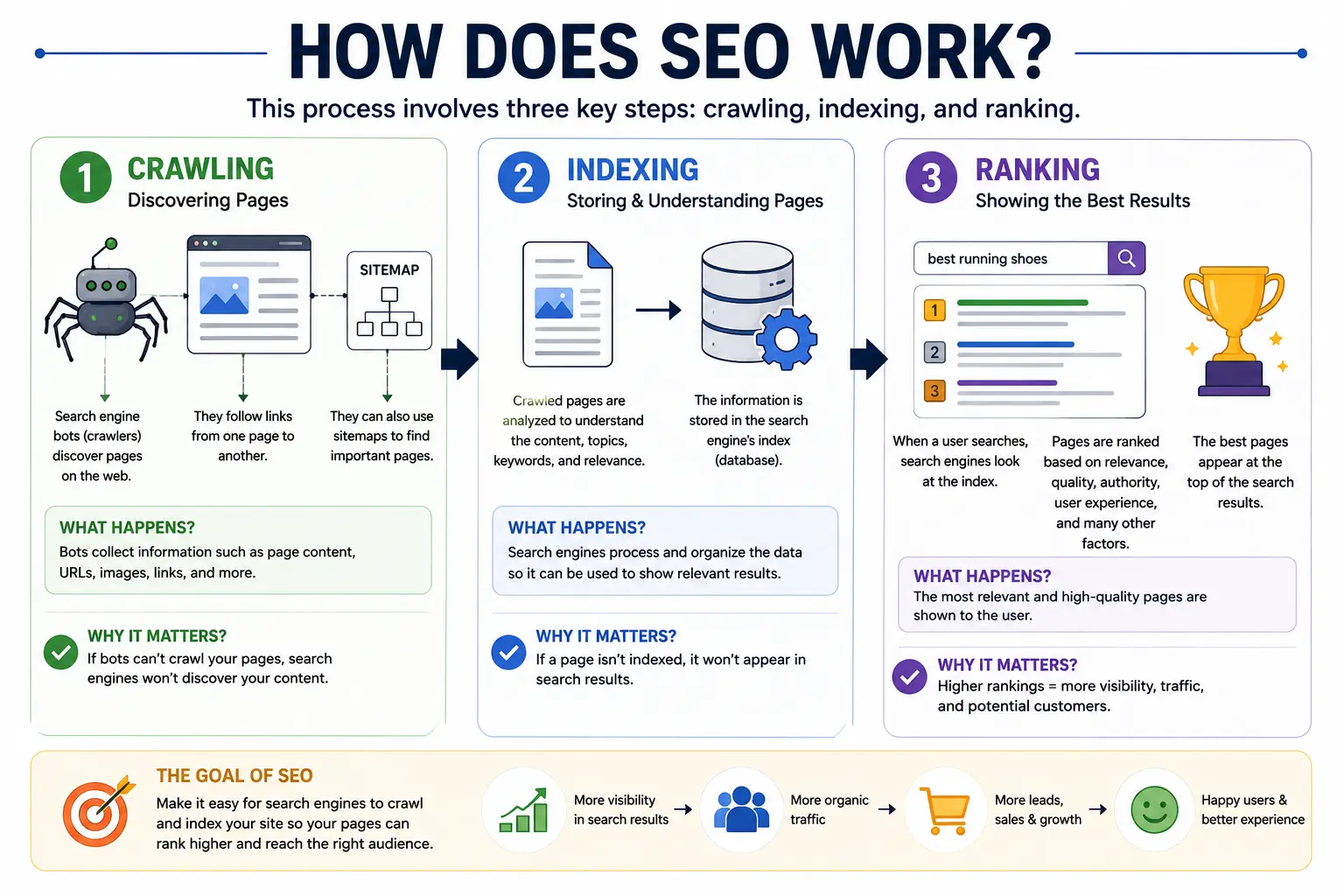
SEO(Search Engine Optimization) is the technique that makes a particular website more visible to search engines like Google.
This process involves three key steps: crawling, indexing, and ranking.
- Crawling: it refers to when search engine bots find web pages on the web using links and sitemaps.
- Indexing: Indexing is the process of storing information about a webpage in the search engine’s database.
- Ranking: Ranking is the position at which a given web page appears in the search results for a particular query based on factors such as relevance, quality, keywords, and user experience.
A website that is well optimised with a quality content, good site speed, and good site structure will have more chance to get your SEO done and help bring more fans coming out from the user online search.
Why is SEO important?
- Increases Website Visibility: SEO helps your website to be shown in a higher position in Search Engine Result Pages.
- Drives Organic Traffic: It delivers free and niche relevant traffic to your website without paid ads.
- Builds Trust and Credibility: Websites ranking on the first page are often seen as more reliable.
- Improves User Experience: SEO encourages fast loading speed, mobile-friendly design, and easy navigation.
- Boosts Brand Awareness: Higher rankings help more people recognise your brand online.
- Generates Quality Leads: SEO attracts users actively searching for your products or services.
- Increases Sales and Conversions: More traffic and easier flow of user experience can result in happy customers and more money.
- Cost-Effective Marketing: SEO results last longer as opposed to paid advertising.
- Helps Beat Competitors: Strong SEO can give your business an advantage over competitor.
- Supports Long-Term Growth: SEO is the type of thing that helps a website grow more and more gradually and consistently over time
What are the types of SEO?
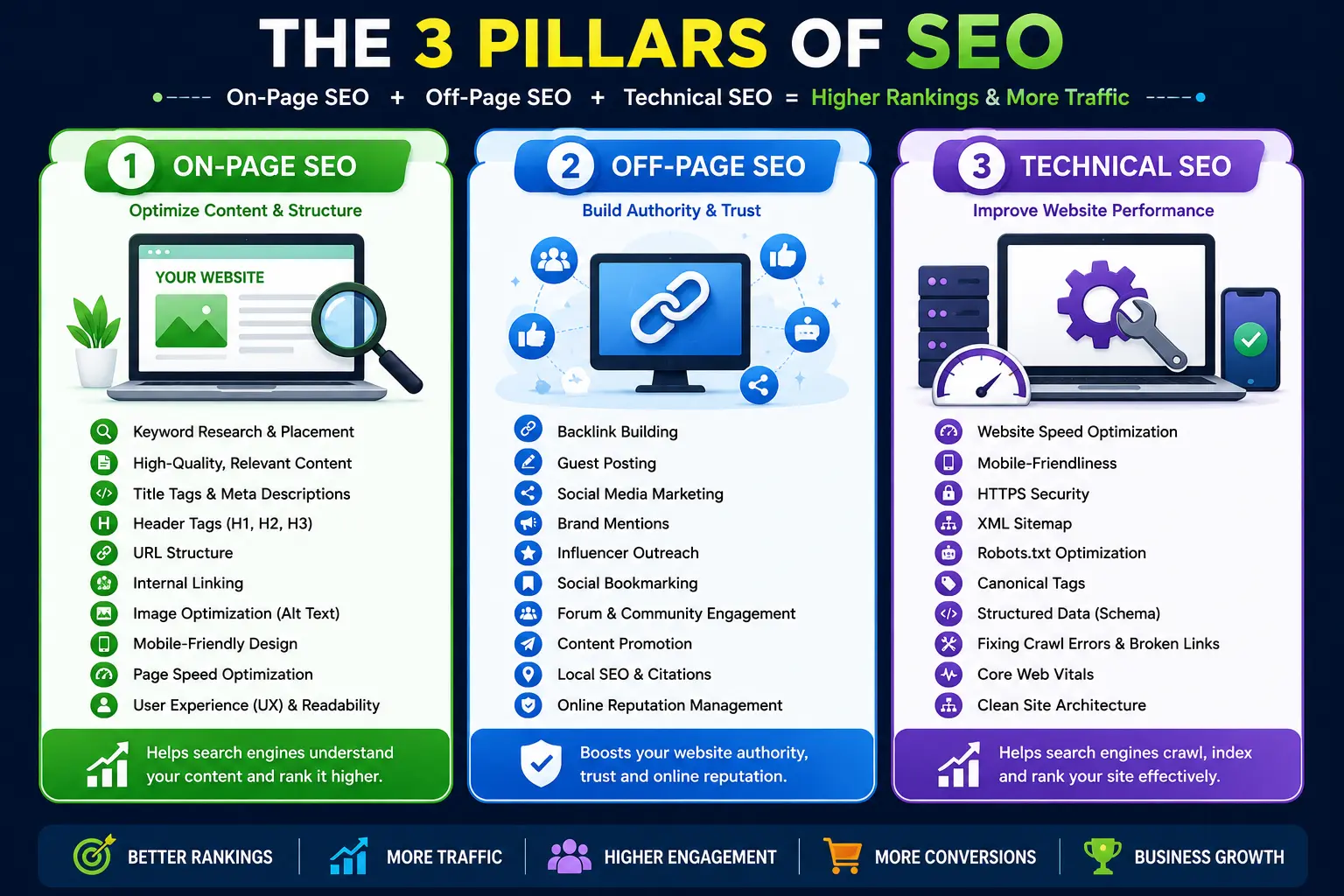
There are three types of Seo: On Page Seo, Off page Seo and Technical Seo
On-Page SEO
On-page SEO is the process of optimising individual pages of a website to improve their search engine rankings and attract more relevant traffic.
In on page seo High-quality, informative, and engaging content with proper header tags plays a major role. Without these, the page is incomplete.
Effective on-page SEO increases website visibility, boosts organic traffic, and helps businesses achieve better online presence and higher conversion rates.
On-Page SEO Activities or Techniques
In on-page seo there are 30 activities or Techniques. Which are:
|
No. |
On-Page SEO Activity / Technique |
Description |
|
1 |
Keyword Research |
Finding relevant keywords users search for. |
|
2 |
Title Tag Optimization |
Writing clear, keyword-rich page titles. |
|
3 |
Meta Description Optimization |
Creating engaging descriptions to improve click-through rates. |
|
4 |
URL Optimization |
Using short, clean, and keyword-friendly URLs. |
|
5 |
Header Tags (H1-H6) |
Structuring content with proper headings for readability and SEO. |
|
6 |
Keyword Placement |
Naturally incorporate keywords in titles, headings and body content. |
|
7 |
Content Optimization |
Creating high-quality, informative, and original content. |
|
8 |
Image Optimization |
Compressing images and using descriptive ALT text. |
|
9 |
Internal Linking |
Linking related pages within the website. |
|
10 |
External Linking |
Linking to trusted external sources for credibility. |
|
11 |
Mobile Friendliness |
Ensuring pages work properly on mobile devices. |
|
12 |
Page Speed Optimization |
Improving website loading speed. |
|
13 |
User Experience (UX) |
Making pages easy to navigate and visually appealing. |
|
14 |
Schema Markup |
Adding structured data to help search engines better understand content. |
|
15 |
Canonical Tags |
Preventing duplicate content issues. |
|
16 |
Alt Text Optimization |
Describing images for accessibility and SEO. |
|
17 |
Content Readability |
Using simple language, short paragraphs, and bullet points. |
|
18 |
Featured Snippet Optimization |
Structuring content to appear in Google snippets. |
|
19 |
E-E-A-T Improvement |
Building Experience, Expertise, Authority, and Trustworthiness. |
|
20 |
Breadcrumb Navigation |
Helping users and search engines navigate the site. |
|
21 |
HTTPS Security |
Using secure SSL certificates for trust and ranking benefits. |
|
22 |
XML Sitemap |
Helping search engines crawl website pages efficiently. |
|
23 |
Robots.txt Optimization |
Guiding search engines on which pages to crawl. |
|
24 |
Anchor Text Optimization |
Using relevant text for internal and external links. |
|
25 |
Duplicate Content Check |
Avoiding copied or repeated content. |
|
26 |
Core Web Vitals Optimization |
Improving loading, interaction, and visual stability. |
|
27 |
Social Sharing Tags |
Adding Open Graph and Twitter card tags. |
|
28 |
Multimedia Optimization |
Optimizing videos, infographics, and other media files. |
|
29 |
Content Freshness Update |
Regularly updating old content with new information. |
|
30 |
SEO-Friendly Formatting |
Using bold text, lists, and proper spacing for readability. |
Things to keep in mind before doing On Page SEO
Here are the things to keep in mind before doing on page seo. Ignorance of anyone will affect your Website ranking.
- Understand the target audience and their search intent
- Perform proper keyword research
- Analyze competitor websites and strategies
- Check website structure and navigation
- Use unique and high-quality content
- Ensure the website is mobile-friendly
- Improve website loading speed
- Use HTTPS for website security
- Create SEO-friendly URLs
- Optimize title tags and meta descriptions
- Use proper heading tags (H1, H2, H3)
- Place keywords naturally in content
- Avoid keyword stuffing
- Optimize images with ALT text and compression
- Plan internal linking strategy
- Add relevant external links when needed
- Check and fix broken links
- Improve user experience (UX) and readability
- Use short paragraphs and bullet points
- Optimize for Core Web Vitals
- Add schema markup for better search visibility
- Verify crawlability and indexing settings
- Create and update XML sitemap
- Check robots.txt configuration
- Use canonical tags to avoid duplicate content
- Add clear call-to-action (CTA) buttons
- Optimize multimedia content like videos and infographics
- Regularly update old content
- Track SEO performance using analytics tools
- Focus on E-E-A-T (Experience, Expertise, Authority, Trustworthiness)
Off-Page SEO
Off-page seo means all the activities done outside of the website to increase the search engine ranking and online reputation of the website. Off Page seo mainly focuses on building high-quality backlinks, increasing brand awareness, and gaining trust from users and search engines.
A Strong Off-Page SEO strategy signals search engines that a website is valuable and credible in result, it will increase website Ranking, visibility, traffic, and improve domain authority.
Off-Page SEO Activities or Techniques
In off-page seo there are 63 activities or Techniques. Which are:
|
S.No |
Off-Page SEO Activity or techniques |
Description |
|
1 |
Backlink Building |
Creating links from external websites to improve authority |
|
2 |
Guest Posting |
Publishing content on other websites for backlinks |
|
3 |
Social Media Marketing |
Promoting content on social platforms |
|
4 |
Social Bookmarking |
Sharing website links on bookmarking sites |
|
5 |
Forum Submission |
Participating in forums with relevant discussions |
|
6 |
Blog Commenting |
Commenting on blogs to gain visibility and links |
|
7 |
Directory Submission |
Submitting websites to online directories |
|
8 |
Article Submission |
Publishing articles on article-sharing platforms |
|
9 |
Press Release Submission |
Sharing company updates with media websites |
|
10 |
Influencer Outreach |
Collaborating with influencers for promotion |
|
11 |
Brand Mentions |
Increasing mentions of a brand online |
|
12 |
Question & Answer Posting |
Answering queries on Q&A platforms |
|
13 |
Local SEO Citations |
Listing business details on citation websites |
|
14 |
Google Business Profile Optimization |
Improving local business profile visibility |
|
15 |
Video Marketing |
Promoting through video content |
|
16 |
Image Submission |
Sharing images on image-sharing platforms |
|
17 |
Infographic Submission |
Publishing infographics for backlinks |
|
18 |
PDF Submission |
Uploading PDF documents online |
|
19 |
Document Sharing |
Sharing documents on document-sharing sites |
|
20 |
Podcast Marketing |
Promoting content through podcasts |
|
21 |
Content Marketing |
Creating and distributing valuable content |
|
22 |
Email Outreach |
Contacting website owners for backlinks |
|
23 |
Broken Link Building |
Replacing broken links with your website links |
|
24 |
Competitor Backlink Analysis |
Studying competitors’ backlink profiles |
|
25 |
Forum Profile Creation |
Creating profiles on forums with website links |
|
26 |
Web 2.0 Submission |
Posting content on Web 2.0 platforms |
|
27 |
Classified Submission |
Posting ads on classified websites |
|
28 |
Business Listing Submission |
Listing businesses on local directories |
|
29 |
Review & Rating Management |
Managing online reviews and ratings |
|
30 |
Event Submission |
Promoting events on event websites |
|
31 |
RSS Feed Submission |
Submitting website feeds for updates |
|
32 |
Social Networking |
Engaging with users on social networks |
|
33 |
Content Syndication |
Republishing content on third-party sites |
|
34 |
Link Exchange |
Exchanging links with relevant websites |
|
35 |
Scholarship Link Building |
Offering scholarships for educational backlinks |
|
36 |
Affiliate Marketing |
Promoting products through affiliates |
|
37 |
Community Participation |
Engaging in online communities |
|
38 |
Influencer Collaborations |
Partnering with influencers for campaigns |
|
39 |
Blogger Outreach |
Connecting with bloggers for promotions |
|
40 |
Profile Creation |
Creating profiles on high-authority websites |
|
41 |
Bookmark Sharing |
Sharing links on bookmarking platforms |
|
42 |
Podcast Guest Appearances |
Appearing on podcasts for brand exposure |
|
43 |
Video Sharing on Platforms |
Uploading videos to sharing websites |
|
44 |
Submission to Niche Directories |
Listing sites in industry-specific directories |
|
45 |
Quora Marketing |
Answering questions on Quora |
|
46 |
Reddit Engagement |
Participating in discussions on Reddit |
|
47 |
Slide Sharing |
Uploading presentations on slide platforms |
|
48 |
Webinar Promotion |
Promoting and hosting webinars |
|
49 |
Online Reputation Management |
Maintaining positive online reputation |
|
50 |
Citation Building |
Creating consistent business citations |
|
51 |
Digital PR |
Using digital media for brand exposure |
|
52 |
Outreach Campaigns |
Running campaigns for backlinks and promotion |
|
53 |
E-book Sharing |
Sharing e-books on document platforms |
|
54 |
Content Repurposing |
Reusing content in different formats |
|
55 |
Local Map Listings |
Adding businesses to online maps |
|
56 |
Social Sharing Campaigns |
Encouraging social media sharing |
|
57 |
Sponsorships & Partnerships |
Partnering with brands or events |
|
58 |
Testimonials & Reviews |
Providing testimonials for backlinks |
|
59 |
HARO Outreach |
Responding to journalists’ queries for backlinks |
|
60 |
Forum Signature Links |
Adding links in forum signatures |
|
61 |
Link Reclamation |
Recovering lost or broken backlinks |
|
62 |
Skyscraper Technique |
Creating improved content for backlinks |
|
63 |
Networking with Industry Websites |
Building relationships with niche websites |
Things to keep in mind before doing off page seo
Here are points to keep in mind before doing off page seo. Ignorance of anyone will affect your Website ranking.
- Understand your target audience and niche
- Analyse competitors’ backlink profiles
- Focus on high-quality backlinks instead of quantity
- Avoid spammy or low-authority websites
- Check website domain authority and relevance
- Use natural and diversified anchor texts
- Maintain backlink relevance to your niche
- Create high-quality and valuable content first
- Ensure the website is technically optimised before link building
- Avoid black-hat SEO techniques
- Follow search engine guidelines and policies
- Build backlinks gradually and naturally
- Monitor backlink quality regularly
- Remove or disavow toxic backlinks
- Focus on websites with real traffic and engagement
- Prioritise do-follow links from trusted websites
- Maintain a balance between do-follow and no-follow links
- Optimise Google Business Profile for local SEO
- Keep NAP (Name, Address, Phone Number) consistent across listings
- Choose the right platforms for submissions
- Avoid duplicate content during guest posting or article submission
- Use attractive and engaging titles for content promotion
- Optimise images, videos, and infographics before submission
- Engage genuinely in forums and communities
- Avoid excessive link exchange practices
- Track off-page SEO performance using analytics tools
- Monitor keyword rankings regularly
- Use social media actively for brand visibility
- Focus on building brand authority and trust
- Ensure mobile-friendly and fast-loading website pages
- Keep content updated and shareable
- Build relationships with bloggers and influencers
- Use proper outreach emails for link-building campaigns
- Verify business listings before submission
- Encourage authentic customer reviews
- Avoid automated backlink generation tools
- Diversify backlink sources
- Focus on long-term SEO growth instead of quick results
- Check the indexing status of submitted links
- Use location-based strategies for local businesses
- Create content that naturally attracts backlinks
- Stay updated with Google algorithm changes
- Maintain consistency in off-page SEO efforts
- Analyse referral traffic from backlinks
- Promote content on multiple channels
- Use ethical white-hat SEO practices only
- Keep competitor monitoring ongoing
- Maintain a strong online reputation
- Measure the ROI of off-page SEO campaigns regularly
Technical SEO
Technical SEO is the process of making a website’s infrastructure easier to crawl, index, and rank for the engines. This consists of website speed, mobile friendliness, XML sitemap, structured data, HTTPS security and fixing broken links or duplicate content. A technically sound site leads to a better user experience and easier navigation, which can have a positive impact on your rank in the SERPS.
Technical SEO is a matter of managing the Core Web Vitals, the site architecture, and the appropriate indexing through canonical tags and robots.txt, among other things. Off-page, fixing the website or business errors can increase the visibility of the business in the search engines, leading to organic traffic and helping the overall marketing of the business. Good technical seo lays a solid foundation for long-term success on the World Wide Web.
Technical SEO Activities or Techniques
In on-page seo there are 60 activities or Techniques. Which are
|
S.No |
Technical SEO Activity / Technique |
Purpose |
|
1 |
Website Speed Optimization |
Improves page loading time |
|
2 |
Mobile-Friendly Design |
Enhances mobile user experience |
|
3 |
HTTPS Security Implementation |
Secures website data |
|
4 |
XML Sitemap Optimization |
Helps search engines crawl pages |
|
5 |
Robots.txt Optimization |
Controls crawler access |
|
6 |
Canonical Tag Implementation |
Prevents duplicate content |
|
7 |
Structured Data / Schema Markup |
Improves rich search results |
|
8 |
Broken Link Fixing |
Removes 404 errors |
|
9 |
Redirect Management |
Maintains SEO value during URL changes |
|
10 |
Core Web Vitals Optimization |
Enhances user experience metrics |
|
11 |
Crawl Error Monitoring |
Identifies indexing issues |
|
12 |
Website Architecture Optimization |
Improves site navigation |
|
13 |
URL Structure Optimization |
Creates SEO-friendly URLs |
|
14 |
Internal Linking Optimization |
Distributes page authority |
|
15 |
Duplicate Content Fixing |
Avoids ranking conflicts |
|
16 |
Image Optimization |
Reduces image load time |
|
17 |
Lazy Loading |
Loads media only when needed |
|
18 |
JavaScript SEO Optimization |
Ensures JS content is crawlable |
|
19 |
CSS & HTML Minification |
Reduces file size |
|
20 |
Browser Caching Setup |
Speeds up repeat visits |
|
21 |
CDN Usage |
Improves global content delivery |
|
22 |
Breadcrumb Optimization |
Improves navigation and indexing |
|
23 |
Pagination Optimization |
Helps search engines understand page series |
|
24 |
Hreflang Tag Implementation |
Supports multilingual SEO |
|
25 |
AMP Optimization |
Improves mobile page speed |
|
26 |
Log File Analysis |
Monitors search engine crawl behavior |
|
27 |
Crawl Budget Optimization |
Prioritizes important pages |
|
28 |
Orphan Page Detection |
Finds pages without internal links |
|
29 |
Indexability Optimization |
Ensures pages can be indexed |
|
30 |
Noindex Tag Management |
Prevents unwanted indexing |
|
31 |
Canonicalization Management |
Consolidates duplicate URLs |
|
32 |
Server Response Optimization |
Improves HTTP status handling |
|
33 |
SSL Certificate Configuration |
Builds website trust |
|
34 |
Website Migration SEO |
Preserves rankings during migration |
|
35 |
Subdomain/Subfolder Optimization |
Organizes website structure |
|
36 |
Faceted Navigation Optimization |
Prevents crawl issues |
|
37 |
Dynamic Rendering |
Helps bots render JS content |
|
38 |
Thin Content Identification |
Improves content quality |
|
39 |
XML Image Sitemap Optimization |
Improves image indexing |
|
40 |
Video SEO Optimization |
Enhances video discoverability |
|
41 |
Structured Navigation Menus |
Simplifies site usability |
|
42 |
Redirect Chain Fixing |
Prevents crawl inefficiencies |
|
43 |
DNS Prefetching |
Speeds up resource loading |
|
44 |
Resource Preloading |
Improves page rendering speed |
|
45 |
GZIP/Brotli Compression |
Compresses website files |
|
46 |
Database Optimization |
Improves server performance |
|
47 |
Server Performance Optimization |
Reduces server response time |
|
48 |
International SEO Setup |
Targets multiple countries/languages |
|
49 |
Accessibility Optimization |
Improves usability for all users |
|
50 |
Google Search Console Monitoring |
Tracks SEO performance |
|
51 |
Bing Webmaster Optimization |
Improves Bing visibility |
|
52 |
HTML Sitemap Creation |
Helps users and crawlers navigate |
|
53 |
Secure Header Configuration |
Enhances website security |
|
54 |
Malware & Spam Monitoring |
Protects site reputation |
|
55 |
Site Rendering Optimization |
Improves crawler rendering |
|
56 |
JS & CSS Compression |
Speeds up loading |
|
57 |
Crawl Depth Optimization |
Improves page discoverability |
|
58 |
Fresh Content Indexing |
Speeds up indexing of updates |
|
59 |
SEO-Friendly Error Pages |
Enhances user retention |
|
60 |
Headless CMS SEO Optimization |
Improves SEO for modern websites |
Things to keep in mind before doing Technical SEO
Here are points to keep in mind before doing Technical seo. Ignorance of anyone will affect your Website ranking.
- Perform a complete website audit
- Take a full website backup
- Check website indexing status
- Analyze current keyword rankings
- Verify Google Search Console setup
- Verify Google Analytics installation
- Understand website architecture
- Review robots.txt file
- Check XML sitemap accuracy
- Identify crawl errors
- Test mobile friendliness
- Analyze website speed
- Ensure HTTPS security is active
- Review canonical tags
- Check redirects (301/302)
- Fix broken links and 404 errors
- Optimize URL structure
- Review internal linking structure
- Identify duplicate content issues
- Optimize images before upload
- Check Core Web Vitals performance
- Review server response codes
- Validate structured data/schema markup
- Optimize crawl budget
- Check JavaScript rendering issues
- Minify CSS, JavaScript, and HTML files
- Enable browser caching
- Use CDN if required
- Review hreflang tags for multilingual sites
- Optimize pagination setup
- Find and fix orphan pages
- Review noindex and nofollow tags
- Improve site architecture and navigation
- Test website responsiveness on all devices
- Analyze competitor technical SEO
- Monitor hosting/server performance
- Maintain clean and optimized code
- Optimize database performance
- Remove unnecessary plugins and scripts
- Plan website migration carefully
- Create SEO-friendly custom 404 pages
- Test forms and interactive features
- Ensure website accessibility standards
- Optimize breadcrumb navigation
- Validate schema markup regularly
- Compress and optimize media files
- Monitor malware and spam issues
- Ensure proper redirect mapping
- Maintain technical SEO documentation
- Continuously track and monitor performance
- Regularly update website software and plugins
- Improve page rendering speed
- Optimize crawl depth
- Monitor index coverage reports
- Avoid redirect chains and loops
- Check DNS and server configuration
- Improve user experience (UX) signals
- Optimize AMP pages if used
- Ensure fast server response time
- Keep website content fresh and updated